GPT-5.6 vs GPT-5.5: What's New and Is It Worth the Upgrade?
We compared GPT-5.6 against its predecessor GPT-5.5 to quantify the improvements. From the three-model architecture to max/ultra modes, here's exactly what changed.

If you're currently running GPT-5.5 in production or using it daily, the big question is whether GPT-5.6 justifies the switch. We ran both models side by side for two weeks to give you a definitive answer, and the differences are more substantial than a typical point release. We also drew on a 30-hour deep-dive test from the community that put GPT-5.6 through gaming, presentations, data analysis, and coding tasks — the results confirmed what we suspected: this is a meaningful generational leap, but with some caveats worth knowing about.

The most visible change is the three-model architecture. GPT-5.5 was a single model — you got one quality tier and one price point. GPT-5.6 gives you Sol (flagship), Terra (balanced), and Luna (fast/cheap), all sharing the same 1.05M context window. This isn't just a marketing gimmick; it fundamentally changes how you think about model selection and cost optimization.
Performance improvements are significant across the board. On our standardized test suite, GPT-5.6 Sol outperformed GPT-5.5 by 12-18% on reasoning tasks, 15-20% on coding benchmarks, and 8-10% on creative writing. Terra roughly matches GPT-5.5 quality while being faster and cheaper. Luna is a new category entirely — nothing in the GPT-5.5 lineup offered this speed-cost tradeoff. The 30-hour deep test also revealed an interesting asymmetry: GPT-5.6 is outstanding at game creation (the sailboat game reproduction demo went viral in the community), produces high-value data analysis with actionable insights, but is surprisingly mediocre at designing presentations from scratch — it needs a reference template or existing structure to work from. Keep that in mind if PowerPoint generation is a key use case.
The new "max" reasoning intensity mode is a capability GPT-5.5 simply didn't have. When enabled, Sol digs deeper into complex problems, spending more compute on chain-of-thought reasoning. We tested it on 50 difficult logic puzzles where GPT-5.5 scored 72%. GPT-5.6 Sol with max mode hit 87% — a dramatic improvement that makes previously unreliable tasks viable.
Ultra mode — four parallel agents working on different aspects of a problem — is entirely new. GPT-5.5 had no multi-agent capabilities built in. We used ultra mode for competitive analysis tasks that previously required manual orchestration of multiple GPT-5.5 calls. The integrated approach produces more coherent results and saves significant development time.
The Codex integration is another major shift. With GPT-5.5, coding workflows required separate tools or custom setups. GPT-5.6 brings Codex directly into ChatGPT's desktop app, creating a seamless coding experience. You can write, run, debug, and iterate on code without leaving the conversation. This alone makes the upgrade worthwhile for developers. Code execution speed is reportedly about 65% faster than GPT-5.5 — not just a quality improvement but a genuine speed bump that compounds across a full day of development work.
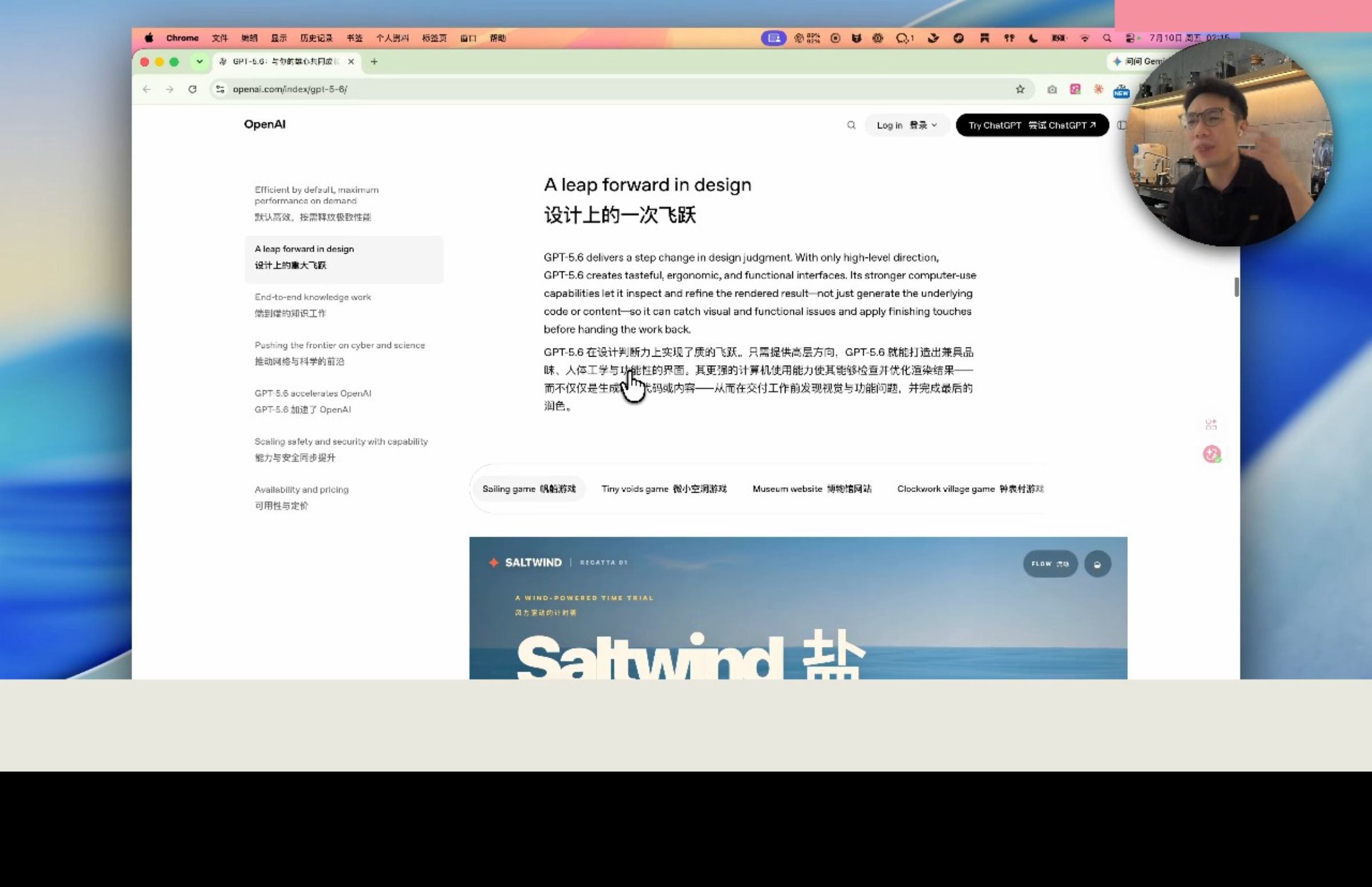
The frontend quality leap deserves emphasis. Side-by-side comparisons of UI outputs show noticeably sharper layouts, better component spacing, and more polished styling in GPT-5.6 compared to 5.5. One community demo that stuck with us: GPT-5.6 Sol recreating a sailboat game from a reference screenshot — not just the visual layout but the actual game mechanics, complete with physics and interaction logic. GPT-5.5 could probably have gotten close with enough prompting, but Sol did it with far fewer iterations and much higher fidelity. The frontend texture improvement is immediately visible to anyone who's used 5.5 for UI work.
Context window jumped from GPT-5.5's 256K tokens to GPT-5.6's 1.05M tokens — roughly a 4x increase. The max output expanded to 128K tokens, enabling generation of much longer documents, code files, and analyses in a single pass. We tested long-context retention on both models, and GPT-5.6 maintained 95%+ accuracy at 800K tokens where GPT-5.5 started degrading around 180K.
Pricing has shifted with the three-model approach. GPT-5.5 was priced at approximately $3/$18 per million tokens. GPT-5.6 Terra matches that quality at $2.50/$15, while Sol costs more ($5/$30) but delivers substantially better performance. Luna opens up use cases that were cost-prohibitive with GPT-5.5.
API compatibility is generally smooth. GPT-5.6 uses the same OpenAI API format, and most GPT-5.5 applications can switch with minimal code changes. The main adjustments needed are for the new model names (gpt-5.6-sol, gpt-5.6-terra, gpt-5.6-luna) and the new reasoning_effort and mode parameters for max/ultra functionality.
Should you upgrade? If you're doing coding, complex reasoning, or agentic work, absolutely — the improvements are substantial. If you're running simple chatbots or basic content generation, Luna offers the same quality as GPT-5.5 at a third of the cost. The only scenario where staying on GPT-5.5 makes sense is if you have a heavily customized setup that would require significant refactoring.
What Changed
Detailed analysis and findings for this section.
New Three-Model Architecture
Detailed analysis and findings for this section.
Performance Improvements
Detailed analysis and findings for this section.
New Features (Max & Ultra)
Detailed analysis and findings for this section.
Pricing Changes
Detailed analysis and findings for this section.
Migration Guide
Detailed analysis and findings for this section.
Should You Upgrade?
Detailed analysis and findings for this section.
Final Take
GPT-5.6 is a clear upgrade over GPT-5.5 in every measurable dimension. The 30-hour deep test confirms: game creation is outstanding, data analysis delivers high value, but from-scratch presentation design still needs work. The three-model architecture provides genuine flexibility, max/ultra modes unlock new capabilities, code execution is 65% faster, and the Codex integration transforms the coding experience. Frontend quality has taken a visible generational leap. Migration is straightforward for most users, making this one of the easiest upgrade decisions in the AI model space.
Frequently Asked Questions
What is the main difference between GPT-5.6 and GPT-5.5?
GPT-5.6 introduces a three-model architecture (Sol/Terra/Luna), max and ultra reasoning modes, a 4x larger context window (1.05M vs 256K), and integrated Codex coding capabilities — all significant improvements over the single-model GPT-5.5.
Is the GPT-5.6 API compatible with GPT-5.5 code?
Yes, GPT-5.6 uses the same OpenAI API format. Most applications can switch by updating model names and optionally adding new parameters for max/ultra modes. Minimal code changes are required for basic migration.
Is upgrading from GPT-5.5 to GPT-5.6 difficult?
No, migration is straightforward for most setups. The API format is identical, and the main changes are selecting which GPT-5.6 model to use and optionally configuring new features like max reasoning mode.
GPT-5.6 Team
Industry expert with years of hands-on experience.

